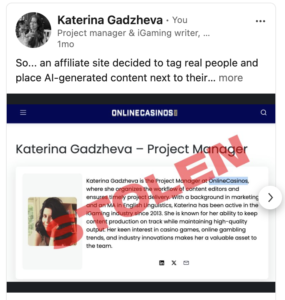
Not long ago, I came across a site I’d never heard of before that used my name, my picture, and my byline without my knowledge or consent.
The site (OnlineCasino) featured me on its About Us page as a Project Manager and Writer. They used one of my old LinkedIn profile pictures and contacts. The worst part? They attributed a lot of AI-generated content to me.
This begs the question…
Why Do So Many iGaming Affiliate Sites Steal Real Authors’ Identities?
The reason is obvious. E-E-A-T is a must if you want rankings on Google and citations with LLM models.
And some of the black-hat SEO tricks circulating include creating large-scale AI-generated content attributed to real people to fool the algorithms.
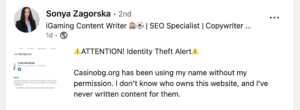
A quick search online or within LinkedIn will give you a decent number of human iGaming writers that are more or less recognizable.
What those fraudulent sites do next is find personal and professional information about them and create a BIO page on their site to boost rankings.
This is the case with the website that stole my identity. OnlineCasino listed 5 other authors and me on their Team page. I did a quick search and contacted all of them. None of my “co-writers” had any idea their names were being used to drive traffic to a low-quality iGaming affiliate site.
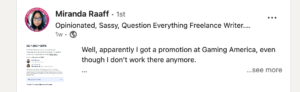
Other cases of identity theft included people used as writers or fact-checkers on sites they no longer worked for. In these cases, several authors who used to write for a big affiliate network find their names still used for online reviews and articles written a week ago, for example.
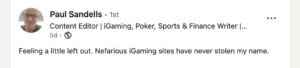
The same reasons apply here. The site owners choose to use established iGaming names rather than create an Author Bio Page for a new writer who doesn’t yet have a strong byline and is not considered an entity.
What Should iGaming Writers Do First When Dealing with Identity Theft Online?
It’s wrong and technically illegal to steal people’s identities online. But the sad reality is that there’s not much you can do at first other than asking them to remove it.
So that’s what I did in my case. I looked for real contacts but, of course, none of the people listed actually worked for this site.
I sent an email to the email address provided on the contacts page but never received a response. Unsurprisingly, I couldn’t get in touch with anyone running the site OnlineCasino.
When I made my case public on LinkedIn, I got a lot of advice from my contacts and followers. Some said that trying to take any action against the culprits would only waste my time and drive me insane. I agree with that to a certain extent.
Another tip was for me to keep an eye on the site and see if they start using my name in Digital PR outreach to the press. Since this is also a possibility.
The best tip by far was a step-by-step action plan for removing your name from the site.
- Screenshots + archive.org every page with your name today, before contacting anyone. Frame the claim as “false employment”.
- If the site is on Cloudflare, file a report at abuse.cloudflare.com; they forward it to the real host, and their reply identifies the real host.
- UK GDPR still exists; ICO if ignored for a month.
- Email compliance at the operators the site promotes, with screenshots. They answer for their affiliates; this cuts the income fastest.
- Google’s RTBF form delists it from searches for your name in the EU.
Why Is This Becoming More of a Problem Today
Identity theft in iGaming has long been a problem, but AI has turbocharged it. And sadly, it is why the whole authorship and expertise thing is slowly becoming meaningless.
The problem is that people still want to take the easy way out. They want sites that appear to have human-written content but without the effort to build them. Instead, they opt for AI-generated slop and stealing people’s identities in an attempt to trick the algorithms.
The best advice I can give my fellow writers is to monitor the web. Setting up Google Alerts or reverse image searches is one way to be alerted should you be the next victim of identity theft.
What still worries me is that even though…
As with all black-hat SEO tricks and hacks, this one will backfire. I just hope that the victims in all this, i.e., the iGaming writers whose identities have been used without their consent, won’t become collateral.